
This piece compares building a real-time chat system on traditional Web2 infra vs Somnia’s Web3 stack, arguing that performance is now matched, but ownership tips the scales.
In 2025, spinning up a chat app using Firebase or Supabase is easy—but scaling it to 100K+ users without incurring massive costs, handling security nightmares, and compromising on data ownership? That’s a whole other story.
Web2 has always prioritized speed over sovereignty. Infrastructure is centralized, data is rented, and users are mere rows in someone else's database. But what if you could keep the same scale and gain ownership?
Enter Somnia, a high-throughput Web3 chain capable of processing over 1 million transactions per second, thanks to MultiStream Consensus and IceDB, its blazing-fast storage engine. Somnia isn't just another blockchain; it’s an execution-grade infrastructure built for real-time, real-scale applications.
In this piece, I’ll break down what it takes to build a chat system on Web2 vs. Somnia, and why future developers might look to Web3, not for ideology, but for performance and control.
Scaling in Web2: The Hidden Cost of Simplicity
Let’s start with the default stack: You deploy your app on Vercel, your backend on Node.js + Express, and your real-time data layer on Firebase or Ably. Everything’s easy… until it’s not.
At 10,000 concurrent users:
You start to pay exponentially more for database Reads/Writes.
Serverless cold starts introduce invisible lag.
Regional failovers become complicated to test and manage.
And through all this, your user data is owned by cloud providers, not your application.
Scaling in Web2 has become pay-to-play, where you rent speed and lose sovereignty.
Most developers think of “scale” as a problem they’ll solve after product-market fit. But what if scale was more than just handling load? What if it was the difference between rented growth and real ownership?
When people say an app “scales,” what they really mean is: It can handle more users, without crashing, while still delivering a good experience, and without costing a fortune.
Let’s break this into three core technical metrics:

Web2 Stack (Firebase, Supabase, or custom backend)
Works great at 1,000 concurrent users.
Starts breaking at 10,000+ without architectural changes (e.g., sharding, load balancers).
Finality isn’t a concern—because you rely on a centralized state.
You don’t own the infrastructure, data, or authentication layer.
Web3 Stack (Somnia)
Capable of 1M+ TPS across domains via MultiStream Consensus.
Sub-second finality (~700ms avg) thanks to IceDB-driven storage.
Each message is immutable, traceable, and owned by the sender.
Wallet-based login: no usernames, no backend session storage.
With Somnia, your chat messages can be real-time, decentralized, and permanent.
Comparing the Experience
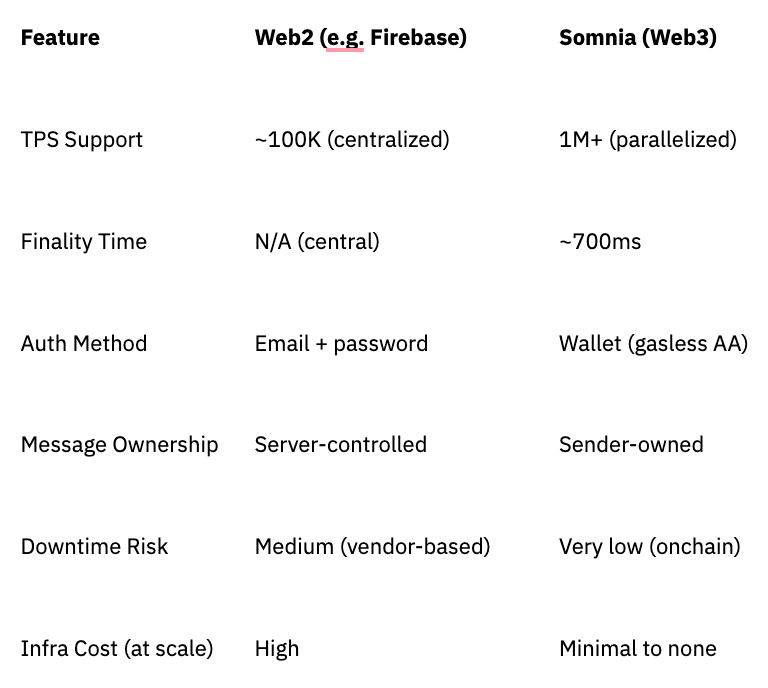
Firebase is fast, yes. But you never truly own your data or infra. Somnia gives you both speed and sovereignty.
Why Ownership Matters at Scale
Ownership is often overlooked in discussions about scale. But if you're building a chat system that becomes global:
Who owns the data?
Can users port their identity elsewhere?
Can the app persist if you stop maintaining it?
Web2 scaling answers these questions with "you don’t."
Web3—and specifically Somnia—answers with "you do."
If Web3 wants to replace Web2 infra, it has to match it on performance—and beat it on ownership. Somnia does both.
The Performance Bottleneck in Web3
For years, Web3 apps were seen as "toy" applications: slow, expensive, and unscalable. Legacy chains like Ethereum L1 offered decentralization but at the cost of:
Throughput bottlenecks (15–30 TPS)
High latency (10–60 seconds finality)
Expensive on-chain storage
Poor UX (gas fees, wallet signing friction)
This made it impossible to build real-time apps like chat systems, games, or marketplaces on the blockchain until now.
Somnia is Built for Execution at Scale
Somnia is a high-throughput, EVM-compatible blockchain built with two fundamental innovations:
1. MultiStream Consensus
Parallel block production across multiple execution domains. Unlike single-threaded consensus, where transactions are processed sequentially, MultiStream allows Somnia to handle multiple transaction streams simultaneously. This eliminates congestion and unlocks horizontal scalability.
2. IceDB
A custom, ultra-fast on-chain storage layer, IceDB, enables sub-second state retrieval for Smart Contracts. Data is compressed, indexed, and query-optimized. Ideal for apps that need real-time reads (like chat, trading, or multiplayer games).
Together, these powers enable Somnia to achieve over 1 million TPS across domains with ~700ms finality.
What Makes Somnia Different?
Most chains try to scale by:
Increasing block size → leads to bloated state.
Adding sidechains → splits liquidity and UX.
Compressing aggressively → slows reads and breaks composability.
Somnia’s approach is native scalability:
MultiStream increases throughput without bottlenecks.
IceDB keeps reads fast, even as the chain grows.
Both work together without compromising decentralization or EVM compatibility.
Real Use Case: Chat Messages as Transactions
In a Somnia-based chat app:
Each message = a transaction → broadcasted and stored.
Query messages via subgraphs or IceDB-backed views.
Account = Wallet (no passwords, no servers).
Optional gasless UX using account abstraction.
This means your app becomes:
Auditable
Unstoppable
Scalable
Owned by its users
Rebuilding a Real-Time Chat App on Web3
Now that we’ve covered the infrastructure, let’s get practical.
If Web3 infra can match Web2 on performance and give users ownership… why wouldn’t you build on it?
Chat is the ultimate stress test for infra. It demands speed, reliability, low latency, and continuous state updates. With Somnia, it’s not only possible—it’s composable, ownable, and unstoppable.
Traditional Chat Stack (Web2)
Let’s say you want to build a real-time chat system today. Here’s what your Web2 stack might look like:
Frontend: React + Socket.IO
Backend: Node.js/Express or Firebase Functions
Real-time Layer: Firebase RTDB, Ably, or Pusher
Auth: Firebase Auth or Auth0
Database: Firestore or PostgreSQL
At scale, traditional chat infrastructure presents several challenges: you incur costs per user and per connection, downtime can result in lost messages, and you don’t truly own your users' data or the infrastructure it runs on. Additionally, you're responsible for manually handling security, moderation, and storage, which adds significant overhead as your user base grows.
Now let’s rebuild this app on Somnia Web3 infra.
Web3 Chat Stack on Somnia
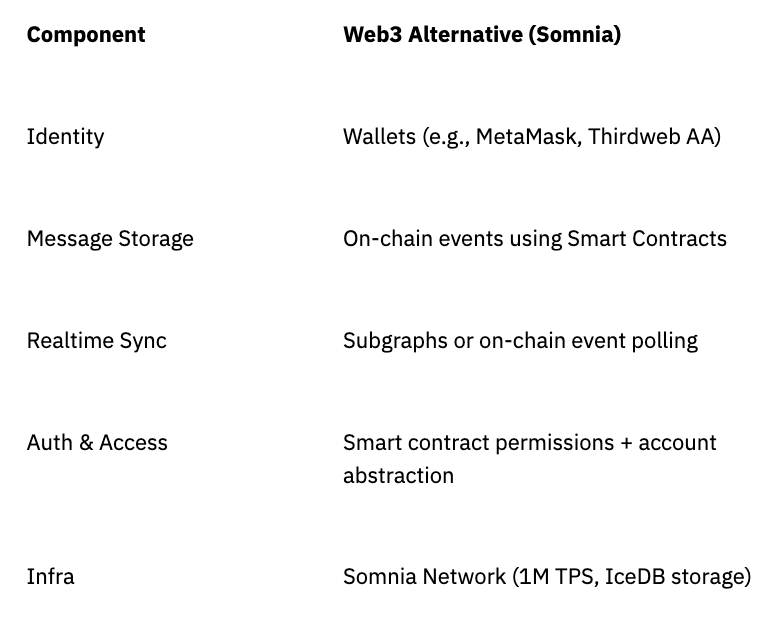
Chat Architecture on Somnia
1. Wallet-based Identity
No email/password combo.
Users sign in with their wallets.
Optional gasless login via Thirdweb's Account Abstraction.
2. Smart Contract for Messaging
Each message is emitted as an on-chain event:
Stored permanently and retrieved via Subgraph or IceDB.
event MessageSent(address indexed sender, string roomId, string content, uint256 timestamp);3. Frontend React App
Users connect wallets.
Submit messages via Smart Contract sendMessage() function.
Listen for MessageSent events in real time.
4. Message Retrieval
Build a subgraph that indexes all MessageSent events.
Filter by roomId and timestamp.
Display in React chat window like you would with Firebase.
Advantages of the Web3 Version
With no vendor lock-in, your protocol and smart contracts operate independently of any backend provider. Messaging becomes uncensorable, as each message is permanently recorded and publicly accessible. The system is fully auditable; any user can verify when a message was sent and by whom. It’s also composable, allowing other dApps to build on your contract without needing permission. Most importantly, it’s ownable: you retain control of the application infrastructure, while your users maintain control of their data.
Developer Notes
You can add rate limiting and moderation using smart contract roles.
IceDB enables fast historical lookup for chat history without pagination delays.
Subgraphs allow near real-time rendering of messages with sub-second latency.
For large-scale rooms, you can shard conversations by room or topic.
Bonus: Add Gamification or Tips
Because you’re on-chain:
Tip users when they send helpful messages (via STT).
Introduce token-gated rooms.
Turn community into a DAO to vote on moderation.
You can’t do that with Firebase!
Why Ownership is the Killer Feature
Speed gets you to market. Ownership keeps you there. In Web3, scale without sovereignty is just shadow growth.
The Illusion of Ownership in Web2
As a Web2 developer, it’s easy to assume you own what you build.
You wrote the code.
You bought the domain.
You spun up the backend.
You control the UI.
But dig deeper:
Your database lives on Firebase or AWS.
Your auth system is powered by Google or Auth0.
Your storage is centralized.
Your infra can be rate-limited, deplatformed, or deleted by third parties.
You don’t own your infra—you rent it. You don’t own your users’ data—Google does. And you can’t carry your community elsewhere if your provider pulls the plug.
Web3 Fixes This — But Somnia Perfects It
Web3’s promise has always been about ownership. Users own their identity, and Developers own their logic (onchain contracts). Communities also own their data and governance models.
But many chains compromise on performance. That’s where Somnia stands apart. Somnia delivers Web2-level scale with Web3-level sovereignty.
With Somnia, you can build applications that never go down, can’t be censored, and are open to being forked or extended by anyone. These apps are designed to outlive their founding teams, ensuring long-term resilience, adaptability, and community ownership.
What Ownership Looks Like in Practice

In a Somnia-based chat app, the protocol is the product. The community can take the smart contracts, fork the front-end, and continue without you—and that’s a feature, not a bug.
You Don’t Just Own the App—You Empower Others to Build On It
Ownership in Web3 isn't just about control—it's about composability. Other developers can build plugins, dashboards, clients, bots, and experiences on top of your app’s data and logic, without asking permission.
Example extensions of a Somnia chat protocol:
A Telegram-style front-end with reactions and threads.
A moderation DAO that curates flagged messages.
A “reply with NFT” feature that issues collectible responses.
That’s impossible in Web2, because there, your app is a black box.
The Risks of Not Owning What You Scale
In 2023, Heroku retired its free tier, and hundreds of small apps disappeared overnight. In 2024, Reddit began charging for API access, crippling third-party clients. In 2025, you could build a thriving Web2 community and lose it all due to a TOS change.
Web3 ensures you’re building on transparent infrastructure that can’t be rug-pulled and belongs to no single entity. With Somnia, you don’t just scale—you own the path forward.
Addressing the Web3 Skeptic: Latency, UX, and Cost
Web3 infrastructure has long been criticized for being too slow, too clunky, and too expensive. But that was before chains like Somnia came along.
This is the first thing you’ll hear when suggesting blockchain infrastructure for real-time applications.
Historically, it was true:
Ethereum: ~15 TPS, 12s block time.
Polygon: ~50 TPS, often congested.
Solana: Higher TPS, but finality takes seconds to confirm.
For chat systems, games, or collaborative apps, that kind of latency is a dealbreaker.
How Somnia Solves It:
MultiStream Consensus processes transactions in parallel.
Finality in ~700ms, comparable to modern Web2 backends.
1M+ TPS capacity ensures low congestion even under load.
You’re no longer trading decentralization for speed. With Somnia, you get both.
“But won’t the UX suffer?”
Let’s be honest: Web3 UX has been historically terrible.
Wallet pop-ups
Confusing seed phrases
Gas fee confirmations
Poor mobile experiences
No user wants to sign a transaction just to send a message.
Somnia + Modern Tooling Fixes:
Account Abstraction (AA) allows for gasless transactions, enhancing accessibility for users. Bundlers work in the background to aggregate and auto-sign messages, streamlining interactions. Embedded wallets like Thirdweb, Privy, and Web3Auth provide smooth, Web2-like sign-in experiences. With progressive onboarding, users aren’t required to set up a wallet until they actually need one, making the journey frictionless and intuitive.
A user can chat for hours without even realizing they’re using a blockchain. That’s the goal.
“Isn’t on-chain storage too expensive?”
Yes, storing arbitrary data like chat messages or images directly on chain is costly on most networks. But that’s no longer the recommended pattern.
Somnia’s Storage Architecture:
IceDB offers efficient, compressed on-chain storage.
You can emit lightweight events that are indexed for querying (e.g. message logs).
For larger payloads (images, files), use hybrid models: IPFS or Arweave for media, onchain hashes for integrity.
This model ensures:
Cheap writes
Fast reads
Verifiable data
On Somnia, a message doesn’t cost dollars. It costs fractions of a cent.
Perception vs Reality
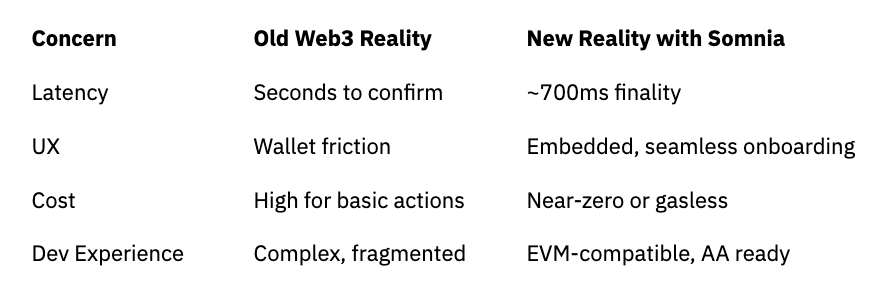
The myth that “Web3 infra isn’t ready” is now outdated. The stack has evolved—and Somnia is proof.
Conclusion
We’ve looked at scale, ownership, infra, performance, and UX. Now we answer the bigger question:
If Web3 is now fast enough, cheap enough, and usable enough…
Why wouldn’t you build on it?
You’ve launched. You’re scaling. But who actually owns your users, your infra, and your future? If it’s not you, why are you building it?
You can no longer claim:
“Web3 is too slow.”
“Too expensive.”
“Too clunky.”
Those limitations are gone, at least if you’re building on Somnia. So now you have to ask a different question:
If Web3 gives you the same speed as Web2, but lets you own your infra, retain your community, and compose your future, why would you keep renting?
Scaling without ownership is merely growing on someone else’s infrastructure, always at risk of external control or disruption. In contrast, growth with ownership enables protocol-driven evolution—resilient and immune to rug pulls. When you build on Somnia, your code lives permanently on-chain, your users bring their own wallets instead of relying on hosted accounts, and your application continues to exist and function even if your startup doesn’t.
That’s not just resilience, it’s empowerment.
If you're building community-driven applications, scaling social or gaming products, or exploring composable infrastructure that others can build upon, then Somnia isn't just an option; it's the most strategic path forward.
Whether it’s chat, games, forums, marketplaces, or collaborative tools, the rules have changed:
You should own what you scale. You can now scale what you own.
Want to Get Started?
Explore the Somnia Developer Docs
Use Thirdweb to create gasless wallets
Join the Somnia Discord to connect with other builders
The infrastructure is ready. The future is composable. All that’s missing is you!
https://somnianetwork.substack.com/?r=12ul6f&utm_campaign=subscribe-page-share-screen&utm_medium=web